The Unicist Research Institute


Global Expansion of the Unicist Confederation

September 23, the 35th equinox of The Unicist Research Institute, was chosen to be the day for the launching of the new stage which consists of the worldwide multiplication of the Unicist Confederation. We invite you to toast on September 23, at 7:00 pm New York time (sharp).

The launching of the collection for business architecture is what allows now the participation of clients in the field of the businesses of the Unicist Confederation: http://unicist.com/ontologies/architecture/

The next stage is the final structural stage. The following stages will deal with conjunctural aspects.

Finally we are, in the Unicist Confederation business, where we needed to be. I would like to make a synthesis of the next business growth period.

Our goal is to build corporate partnerships with the major clients. That is what will expand the business. We will start dealing with 40 corporations. Partnerships are only possible between peers. This is what TURI, the Unicist Confederation and the Unicist Corporate University are about.

We have the major gravitational force that can be available for a business, which is the research of The Unicist Research Institute (4,100 until September), which continues growing. http://www.unicist.com/

We also have a live gravitational force which is Peter Belohlavek who might be one of the major scientists in the history of humanity because of the depth of his discoveries and the width of his research in complexity sciences. The discovery of the ontogenetic intelligence of nature, the unicist ontology of evolution and human ontointelligence are a demonstration of the depth of the researches that changed the world forever.

The Unicist Business Architecture is now the participative bridge between science and business, it allows everyone to influence with a grounded or groundless opinion.

From now on Peter Belohlavek will be only participating as a scientist to sustain the Unicist Confederation.

We have to become world leaders in the commercial field in six months using the power of the technologies applied to business expansion (including both growth and improvement). March 2012 is the deadline. It has to be the demonstration of an “avalanche”.

Considering the ontology of growth that is in the book of the Crisis 2008, we can say that we have all what is needed to “multiply”. Growth is the most difficult problem to be solved in business. That is why we are there, and the unicist research found the solution for it.

We invite you to toast and participate in the new stage.

Diana Belohlavek
VP Global Markets
& Market Labs

NOTE: The Unicist Research Institute is a pioneer in complexity science research. More than 4,000 ontological researches were developed since 1976 until July 2011 in the field of individual, institutional and social evolution. They allowed describing the “DNA” of institutions, defined by the ontogenetic algorithms of their functions, and manage them using ontology based and business object driven solutions.

Share

Unicist Business Platforms include the ontology of growth

The unicist business platforms are based on the ontological algorithm for business growth. This is what makes the platforms work as virtual business units.

Business Growth is implicit in the architecture of a business. The context for structural growth is defined when the architecture has been designed. But it has to be considered that structural growth is in the details of the architecture and between the lines of the work procedures.

The unicist ontology of economic growth was discovered in 1989 after 10 years of research and country scenario building. Since then, its application to business growth drove to multiple experiences until it could be confirmed in 2011. The Unicist Research Institute used this ontology to grow from a pioneer in 1976 to where it is now.

The unified field of business growth, in unicist standard language, includes:

  1. A context for growth, which is defined by the implicit vision of a company.
  2. The economic growth algorithm: driven by technology, value generation and institutionalization.
  3. Synchronicity: driven by opportunity, critical mass and added value.
  4. Timing: driven by synchronicity, acceleration of actions and speed of actions.
  5. Action: driven by value adding displacement, focused energy and work.

The algorithm for growth allows, on the one hand, diagnosing the possibilities of structural growth, defining its strategy and implementing the business processes to build it.

On the other hand, it defines the possibilities of conjunctual growth. Conjunctural growth implies actions that only drive to the growth of revenue that cannot be incompatible with the above described unified field of the growth algorithm.

We invite you to be our guest at the Unicist Library to access the collection of books on Unicist Business Architecture: http://www.unicist.com

Peter Belohlavek

NOTE: The Unicist Research Institute is a pioneer in complexity science research. More than 4,000 ontological researches were developed since 1976 until July 2011 in the field of individual, institutional and social evolution, including the development of ontology based and business object driven solutions for businesses.

Share

Global Launching: Intra-outsourcing of IT activities

Today we are launching the Unicist IT Business Platform to transform IT activities into business units including the use and development of business objects to increase the value added.

The evolution of hardware and software widened the possibilities of information technologies to provide peopleware, in terms of work processes that allow increasing notoriously the value generation and the competitive capacity.

The unicist natural organization integrated with business objects allows upgrading the IT activities transforming them into virtual business units.

This platform includes business objects for:

  • client centered management,
  • WS-automation,
  • unicist project management,
  • CRM,
  • object oriented costing (ABC spin-off),
  • continuous improvement,
  • reliability,
  • prototyping,
  • business architecture emulation,
  • life-cycle management.

The investment of the transformation is recovered within the first year.

We invite you to be our guest at the Unicist Library to access the book “Unicist Business Architecture”:
http://www.unicist.com

Executive Committee

NOTE: The Unicist Research Institute is a pioneer in complexity science research. More than 4,000 ontological researches were developed since 1976 until July 2011 in the field of individual, institutional and social evolution, including the development of ontology based and business object driven solutions for businesses.

Share

Time for business multiplication has come

The research in the field of human adaptive behavior allowed having a complete set of ontologies and business objects to develop business growth.

This triggers now the multiplication activities of the academic arm and the business arm taking advantage of the knowledge of the nature of cultural, institutional and individual behavior.

There are four types of businesses based on the objective characteristics of the activity or the subjective attitude of their leaders:

1) Difference making businesses
2) Dividing businesses
3) Adding businesses
4) Multiplying businesses

Difference making businesses are those where the revenue is made by sales and profit is produced by the buying of what is sold (e.g. small retail businesses). Threat: lack of growth.

Dividing businesses imply prevailing in the confrontation between something that exists and what is being proposed to buy (e.g. consultants). Threat: lack of credibility.

Adding businesses are those where something is being built based on objective value (e.g. industrial businesses). Threat: commoditization.

Multiplying businesses are those driven towards massive contagious expansion of the businesses (e.g. market driven businesses). Threat: inaction (nill).

The Unicist Research Institute is the pioneering research organization in the field of human adaptive systems, which allows building a multiplying business based on the expansion of our partners’ network providing business expansion to the markets.

Our business it to build businesses for our partners and their business is to build growth for companies.

Time for multiplication has come.

We invite you to be our guest at the Unicist Library to access the book “Unicist Business Architecture”:
http://www.unicist.com

Peter Belohlavek

NOTE: The Unicist Research Institute is a pioneer in complexity science research. More than 4,000 ontological researches were developed since 1976 until July 2011 in the field of individual, institutional and social evolution, including the development of ontology based and business object driven solutions for businesses.

Share

The Nature of Universal Strategy

The nature of reality is described by the ontology that defines its functionality. Therefore ontologies are timeless and cross-cultural.

Strategy has its origin in military actions. Its etymology derives from “strategos”: the art of the general. Strategy has been applied to all uses where an influence needs to be exerted to achieve a goal.

A strategic approach is a must when dealing with complex adaptive systems like businesses.

The origin of the unicist ontology of Universal Strategy has been Sun Tzu, who has been the originator of a conceptual approach to strategy.

Invincibility depends on one’s self; the enemy’s vulnerability on him. – Sun Tzu, The Art of War. c.400-320 b.c.

The concept described by Sun Tzu allowed defining the hypothesis of the ontology of strategy, and its multiple applications allowed confirming it. The ontological approach makes strategies understandable, reasonable and provable.

If you are interested in managing the strategy of your activity we strongly recommend studying The Art of War. But you need to go beyond the operational meaning of his words and apprehend the nature of what Sun Tzu is saying.

We invite you to be our guest at the Unicist Library to access the book : “Unicist Business Strategy”:
http://www.unicist.com

Peter Belohlavek

NOTE: The Unicist Research Institute is a pioneer in complexity science research. More than 4,000 ontological researches were developed since 1976 until July 2011 in the field of individual, institutional and social evolution, including the development of ontology based and business object driven solutions for businesses.

Share

Unicist Business Platforms to increase Growth and Profit

The objective of a Unicist Business Platform is to install a result driven organization model that allows ensuring the results of businesses to generate growth and increase profit.

It uses the Unicist Business Architecture to develop businesses as adaptive systems ensuring the results by the use of a high level of automation to transform the solutions that are developed by the prototypers into final systems to manage the business processes.

The differentiated aspects of the unicist technologies are the use of “Business Objects”, prototypers and automated processes to develop the systems. This ensures that the results of growth and profit improvement can be achieved.

The unicist organizational design uses prototypers to develop the prototype that is finally transformed into the system to be used in a business unit.

Access the White Paper on Unicist Business Architecture at:
https://www.unicist.org/conceptual-thinking/wp-content/uploads/2011/08/wp_unicist_business_architecture_en.pdf

Prototypers are extremely flexible operational units that are used in destructive and non-destructive pilot tests to define a prototype of an organizational process.

We invite you to be our guest at the Unicist Library to access the book : “Unicist Business Architecture”:
http://www.unicist.com

Diego Belohlavek
Expert System &
Business Platform Manager

NOTE: The Unicist Research Institute is a pioneer in complexity science research. More than 4,000 ontological researches were developed since 1976 until July 2011 in the field of individual, institutional and social evolution, including the development of ontology based and business object driven solutions for businesses.

Share

Expanding markets using white papers

Commercial white papers are universal tools to inform clients of what is behind of what is being sold.

But white papers are extremely useful in some cases and extremely useless in others. It is necessary to understand their nature in order to define when and how to use them and how to design their content.

A commercial white paper explains the solution that is behind a product or service. It is not a description of a product or a service; that is the functionality of a brochure.

The design of white papers needs to be neutral, it cannot sell anything. It is implicitly a “teaching material”, which means that it has to be focused on providing something useful.

Therefore, commercial white papers have to be useful information for the market that helps readers to solve a problem.

They need to provide the basics of the technology that sustains the solution of the problem and need to be sustained by the authoritative role that is implicit in the brand of the company. If the brand doesn’t suffice, a personal, credible and authoritative role can be a substitute for it.

The adequate use of white papers allows expanding the boundaries of a business into other areas where the solutions provided are useful.

Some typical markets for the use of white papers are: medicine, technology, industry, knowledge businesses, information technology, sports, etc.

We invite you to be our guest at the Unicist Library:  http://www.unicist.com

Peter Belohlavek

NOTE: The Unicist Research Institute is a pioneer in complexity science research. More than 4,000 ontological researches were developed since 1976 until July 2011 in the field of individual, institutional and social evolution, including the development of ontology based and business object driven solutions for businesses.

Share

Business Modeling: Using questions and answers in business

Businesses are, by definition, conscious activities to satisfy needs. Businessmen/women can approach these needs based on the answers they have or based on the questions they pose.

Selling only “black cars” is an answer driven approach; researching which color of cars are desired is a question driven approach.

People who do what they believe are answer driven. People who do what is needed are question driven.

Question driven businesses are, by nature, “liberal” because the input comes from the needs of the market. Answer driven businesses are “conservative” because the needs are defined by the businessmen/women.

Minimum strategies of businesses, which are those that are under the control of a company, can be managed with answers. Methods, rules and guidelines are defined ways to develop an activity and are homologous to what we call answers.

Maximal strategies of companies, which expand the boundaries of businesses, need to be managed based on the questions. The problem is to understand what the market is saying. The answers are, by definition, ambiguous and require understanding the unified field of the business in order to be interpreted.

Maximal strategies require “liberals” and minimum strategies require “conservatives” to manage businesses.

Managing questions makes the introjection of the needs of the market possible; managing answers implies projecting one’s decisions. Business modeling requires both approaches to be successful.

We invite you to be our guest at the Unicist Library:  http://www.unicist.com

Peter Belohlavek

NOTE: The Unicist Research Institute is a pioneer in complexity science research. More than 4,000 ontological researches were developed since 1976 until July 2011 in the field of individual, institutional and social evolution, including the development of ontology based and business object driven solutions for businesses.

Share

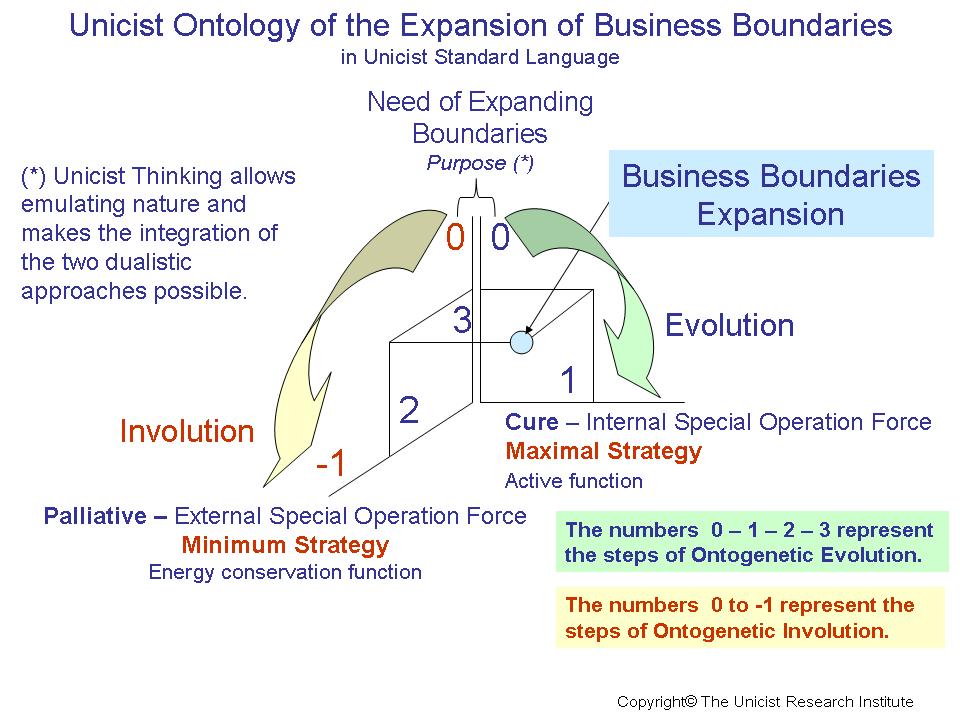
Expanding the boundaries of businesses in order to grow

The expansion of the boundaries of a business implies that those who manage it need to expand the unified field of the business they have in their mind.

Businesses need to be envisioned in their processes and results in order to be managed. The expansion of boundaries can only be managed by those who have a precise vision of the new boundaries that need to be achieved.

Every individual has boundaries in her/his mind that provide the security framework to adapt to the environment. Time to adapt is necessary for an individual to expand the boundaries of a business.

Therefore, the expansion of boundaries of businesses, which is a condition for growth, requires a strategy in which companies need to have the people to make it happen.

The starting actions require the implementation of a “Special Operation Force” (SOF) that has the capacity to deal with the new boundaries having no pre-concepts driven by the preexisting limits.

The natural way to do so is by integrating to this force, members of the company that have the capacity but were not involved in the preexisting boundaries. This avoids change resistance and innovation blindness. An external SOF is needed as a palliative to save energy.

As a transition, for the starting point, an external SOF, provides a minimum strategy that establishes a safer environment for the internal SOF. It is a price that needs to be paid in all the cases in which the new boundaries imply an extension of the concept of the products, services or solutions sold.

We invite you to be our guest at the Unicist Library:  http://www.unicist.com

Peter Belohlavek

NOTE: The Unicist Research Institute is a pioneer in complexity science research. More than 4,000 ontological researches were developed since 1976 until July 2011 in the field of individual, institutional and social evolution, including the development of ontology based and business object driven solutions for businesses.

Share

Unicist Business Platforms structure Business Units

Companies have two customers: their market and their shareholders.

Unicist Business Platforms are integrated business processes that foster business expansion while covering the administrative aspects or integrating them within.

UBPs use unicist business objects to ensure the results of the work processes. Thus UBPs structure a business unit including its expansion, decision support, control and operational systems.

The maximal strategy is driven by the adaptive system including both the expansion and the decision support systems. This allows expanding the boundaries of a business and structuring it to make it stable.

As a business unit, it needs to be measured by results which include both growth and profit. The transformation of cost centers into business units implies that the business might have external and/or internal clients.

It has to be considered that the concept of transforming cost centers into business units is an extension of boundaries in itself.

We invite you to be our guest at the Unicist Library:  http://www.unicist.com

Peter Belohlavek

NOTE: The Unicist Research Institute is a pioneer in complexity science research. More than 4,000 ontological researches were developed since 1976 until July 2011 in the field of individual, institutional and social evolution, including the development of ontology based and business object driven solutions for businesses.


Share